Agentic AI in Digital Marketing is becoming one of the most important developments in digital marketing in 2026. Unlike traditional AI tools that mainly generate content or provide recommendations, AI agents can work toward a goal, plan multiple steps, use different tools, take actions and adjust based on results. Google describes this shift as moving toward agents that can reason through tasks and act on a user’s behalf.
For marketers, this means Agentic AI in Digital Marketing is moving beyond simple automation toward AI-powered marketing execution. From campaign optimization and SEO research to customer engagement and personalization, agentic AI can potentially handle complex workflows while marketers remain responsible for strategy, creativity and oversight.
1. What Is Agentic AI in Digital Marketing?
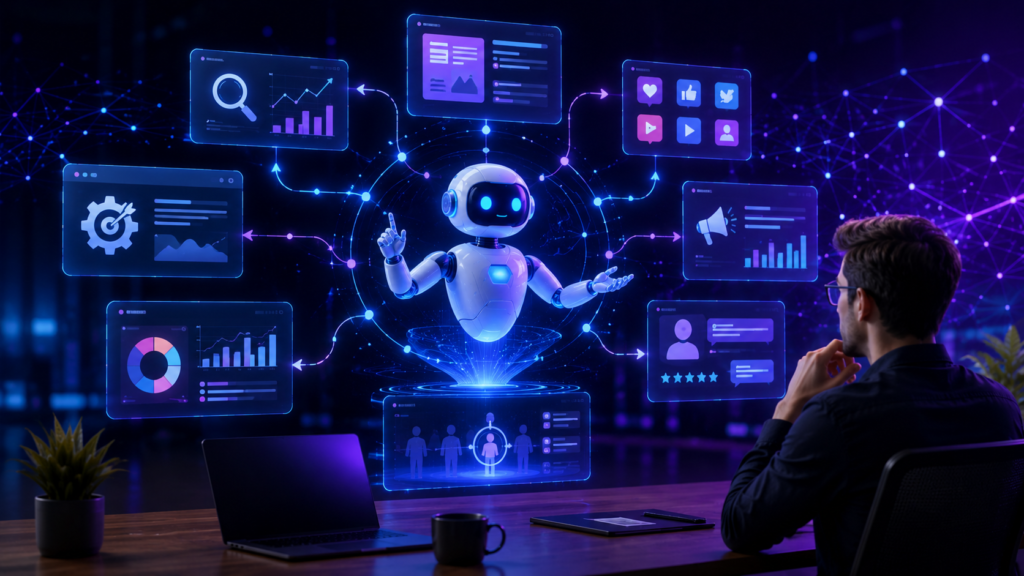
Agentic AI in digital marketing refers to AI systems that can independently perform multiple steps to achieve a marketing objective.
Traditional automation generally follows predefined rules:
If X happens → perform Y.
Agentic AI in Digital Marketing works differently:
Understand the goal → create a plan → perform actions → analyze results → adapt the next action.
For example, instead of asking an AI tool to simply write a blog post, an AI marketing agent could research a topic, identify relevant keywords, create an outline, draft content, check optimization opportunities and prepare supporting content for different channels.
This shift is already visible across the marketing industry. Forrester reported in June 2026 that half of U.S. marketing agencies surveyed were using agentic AI for marketing execution.
The important point is that agentic AI doesn’t necessarily mean removing marketers from the process. The most effective approach is often AI agents handling repetitive execution while humans provide strategy, brand direction and approval.
How Agentic AI in Digital Marketing Is Changing Digital Marketing
Agentic AI in Digital Marketing can influence almost every stage of the digital marketing process.
SEO and Content Marketing
An AI agent can assist with keyword research, competitor analysis, content planning, optimization and performance monitoring. Instead of completing one isolated task, the agent can connect several activities into a workflow.
For example:
Keyword research → competitor analysis → content brief → content creation → SEO checks → performance monitoring
This can make content operations faster while allowing marketers to spend more time on original ideas, expertise and brand positioning.
Paid Advertising
AI-powered marketing platforms are increasingly moving toward proactive recommendations and automated optimization. Google has introduced AI and agentic experiences across Google Ads and Analytics to help marketers identify insights and take action faster.
An agent could potentially help analyze campaign performance, identify underperforming segments, recommend creative changes and prioritize optimization opportunities.
Customer Engagement
Agentic AI can also help businesses interact with customers around the clock. In India, Google has introduced Business Agent for Leadhttps://akanshifymedia.com/services/s, allowing customers to chat with an AI agent inside certain ads to ask questions and receive responses based on the advertiser’s website.
This could make lead qualification and customer communication much faster.
Benefits of Agentic AI in Digital Marketing for Businesses
The biggest advantage of agentic AI is not simply generating content faster. Its real potential is connecting multiple marketing activities into intelligent workflows.
Increased Productivity
Marketing teams can delegate repetitive research, reporting and optimization tasks to AI agents.
Faster Decision-Making
Agents can analyze large amounts of marketing data and identify patterns much faster than manual analysis.
Better Personalization
AI agents can use customer signals and context to help create more relevant experiences and communications.
24/7 Marketing Operations
Unlike human teams, AI agents can continuously monitor campaigns, customer interactions and marketing data.
Scalable Marketing
Small businesses can potentially accomplish more marketing work without increasing their teams at the same rate.
Google’s 2026 AI Agent Trends report highlights productivity, automated workflows and personalized customer experiences as important areas where AI agents can reshape business operations.
Challenges and Risks of Agentic AI in Digital Marketing in Marketing
Although Agentic AI in Digital Marketing offers major opportunities, businesses should not treat AI agents as completely independent marketers.
Brand Consistency
An AI agent may produce content that doesn’t fully match a company’s tone, values or positioning. Clear brand guidelines and approval processes are essential.
Data Privacy
Marketing agents may work with customer and business data, making proper security and access controls important.
Incorrect Decisions
AI systems can make mistakes or act on incomplete information. Human review is particularly important for high-impact campaigns.
Loss of Creativity
Overusing AI can make marketing content repetitive and less distinctive. Forrester’s 2026 research specifically warns that an excessive focus on AI-driven productivity and cost reduction can undermine creativity and differentiation.
Need for Human Oversight
The strongest approach is generally human + AI, rather than AI replacing the entire marketing team. Businesses should define what an agent can do independently and where human approval is required
The Future of Agentic AI in Digital Marketing
The future of digital marketing is moving from AI-assisted marketing toward AI-agent-driven workflows.
Search itself is also becoming more agentic. Google announced new Search capabilities in 2026 that allow users to create and manage information agents and use AI to perform more complex tasks.
This creates an important change for marketers: brands may increasingly need to optimize not only for human consumers, but also for the AI systems helping consumers discover, evaluate and choose products and services.
In other words, digital marketing is moving from:
Human searches → websites → human decisions
toward increasingly complex journeys involving:
Human intent → AI search/agents → brand information → recommendations → action
For businesses, this makes high-quality information, strong branding, trustworthy content, structured data and excellent customer experiences increasingly important.
Conclusion
Agentic AI in Digital Marketing is more than another AI trend. It represents a shift from tools that simply assist marketers to systems that can plan, execute, analyze and optimize parts of the marketing process.
In 2026, businesses that learn how to combine AI agents + human creativity + strategic oversight can potentially build faster, more personalized and more scalable marketing operations.
The goal shouldn’t be to replace marketers with AI. The goal should be to let AI handle repetitive execution while marketers focus on what humans do best: strategy, creativity, relationships and brand building.